


Views: 0 Author: ECHELON Publish Time: 2026-11-17 Origin: Site


Small electric boats leave little room for power electronics. A 2-in-1 unit that combines the onboard charger with a DC-DC converter can charge the traction battery and power the 12V system from a single enclosure — but only if the voltage platform, DC-DC output, sealing, and mounting all match the boat.
For larger vessels, separate chargers and converters are often practical. For compact craft — small outboard-powered boats, tenders, and light workboats — every kilogram, every cable run, and every mounting surface matters. That is where an integrated unit earns its place, and where a wrong selection shows up fastest.
This guide explains how to choose a 2-in-1 onboard charger for a small electric boat, using the 48V and 72V platforms most common in this class.
A small electric boat needs two power functions: charging the traction battery from shore power, and supplying the low-voltage system that runs the controller, instruments, lighting, pumps, and communications.
With separate components, the boat carries two enclosures, two sets of high-voltage and low-voltage connections, and two mounting positions. Each connection is a potential water-ingress point, and each enclosure competes for space in a hull that has very little of it.
A 2-in-1 OBC + DC-DC unit integrates both functions in one housing. The charger provides controlled charging for the traction battery, while the DC-DC converter supplies stable low-voltage power for auxiliary loads. Fewer components means simpler wiring, fewer connectors exposed to the marine environment, and one unit to mount, seal, and service.
The trade-off is concentration: both functions share one enclosure, one cooling path, and one installation position. That makes correct sizing and mounting more important, not less.
The charger must match the boat's battery platform — not approximately, but across the full charging voltage range of the installed pack.
Small electric boats commonly use 48V or 72V battery systems, and a 2-in-1 unit is built for one platform or the other. The nominal voltage alone does not describe the full requirement: the charger must cover the pack's minimum and maximum charging voltages and deliver appropriate current throughout the charging profile.
Version | Battery platform | OBC rated power | Communication | Cooling | Protection rating |
|---|---|---|---|---|---|
48V | 1.5kW | CAN | Air cooling | IP67 | |
72V | 1.5kW | CAN | Air cooling | IP67 |
Both versions use CC/CV charging control and provide over-voltage, under-voltage, over-current, short-circuit, and over-temperature protection. Charging voltage, current, and CAN communication can be configured for OEM projects according to the battery system and vehicle requirements.
Provide the charger supplier with the battery nominal voltage, the full charging voltage range, the maximum permissible charging current, the battery chemistry and charging strategy, and any BMS-controlled charging limits. Two boats described as "48V" can still require different charging parameters.
The DC-DC converter must supply every low-voltage load that can run at the same time, with margin — not just the average load.
Before selecting a unit, list the boat's 12V loads and identify which ones run simultaneously: the vehicle controller, navigation and deck lighting, instruments and displays, bilge pump, communications equipment, and any powered accessories. Then confirm the power draw of each load from its own equipment documentation, add the simultaneous loads together, and check the total against the converter's rated output with headroom for inrush currents and future additions.
A converter sized only for the average load will trip, overheat, or shut down on the day everything runs at once — typically the day the boat is working hardest.
If the simultaneous load exceeds what a compact 2-in-1 converter can supply, the architecture needs to change: either a larger DC-DC stage or a separate converter. That decision should be made from the load budget, not discovered during sea trials.
An IP67 rating addresses defined dust-ingress and temporary water-immersion test conditions. On a boat, that baseline matters more than on a road vehicle because water exposure is constant rather than occasional: spray, washdown, bilge humidity, and rain all reach the installation space.
But IP67 alone does not settle marine suitability. It does not automatically establish resistance to high-pressure washing, salt corrosion, vibration, or thermal cycling, and it says nothing about the connectors, cable entries, and mounting hardware around the unit.
Review the mounting position relative to splash and standing water, the direction and sealing of connectors and cable entries, the materials of brackets and fasteners, and the maintenance access for inspection. The installation should be assessed as part of the complete boat, including the worst realistic water exposure — not the showroom condition.
For a broader view of marine charging requirements, see our overview On-Board Charging for Electric Boats and Marine Applications.
On a small boat, the charger rarely works alone. The battery management system owns the battery's charging limits, and a controller may coordinate charging authorization, system states, and diagnostics.
CAN communication connects these systems in many marine and EV architectures. But matching the physical CAN interface is only the starting point. The charger, BMS, and controller must also agree on message definitions, charging commands, timeout behavior, fault reporting, and software version management.
Two questions deserve attention early:
What happens if CAN messages stop arriving? The charger needs a defined safe behavior — typically stopping or limiting charging — rather than continuing on the last received command.
Who can stop charging, and how? The BMS, the controller, and the charger itself may each need a path to stop charging during a fault. That responsibility should be defined before integration, not during testing.
For the full coordination picture, see our guide AC On-Board Charger Integration for Commercial & Specialty EVs: 7 Questions OEMs Should Answer.
An air-cooled charger needs airflow, and a small hull rarely offers much of it. A unit that performs well on the bench can overheat in a sealed compartment with no ventilation path.
Before finalizing the installation, confirm:
Airflow: Is there a ventilation path to and from the unit, and is it clear of obstructions in normal use?
Orientation: Is the mounting orientation permitted by the supplier, and does it keep connectors and cable entries facing away from direct water?
Heat neighbours: Are batteries, motor controllers, or other heat sources raising the local ambient temperature beyond the charger's operating range?
Vibration and shock: Is the mounting rigid enough for hull vibration and wave impact, without stressing the enclosure or connectors?
Service access: Can the unit be inspected, disconnected, and replaced without removing other equipment?
Requirement | Information to confirm | Why it matters |
|---|---|---|
Battery platform | 48V or 72V, full charging voltage range | Determines which version fits |
Charging power | Required power and charging time | Supports the 1.5kW selection |
12V load budget | Simultaneous auxiliary loads | Sizes the DC-DC output |
Communication | CAN messages and charging commands | Enables coordinated charging control |
Installation | Space, airflow, orientation, connectors | Determines mounting feasibility |
Environment | Water exposure, salt, vibration | Defines sealing and materials review |
Project plan | Sample quantity, validation schedule, SOP | Supports development planning |
The more clearly these requirements are defined, the easier it becomes to determine whether an existing 2-in-1 configuration fits or whether customization is needed.
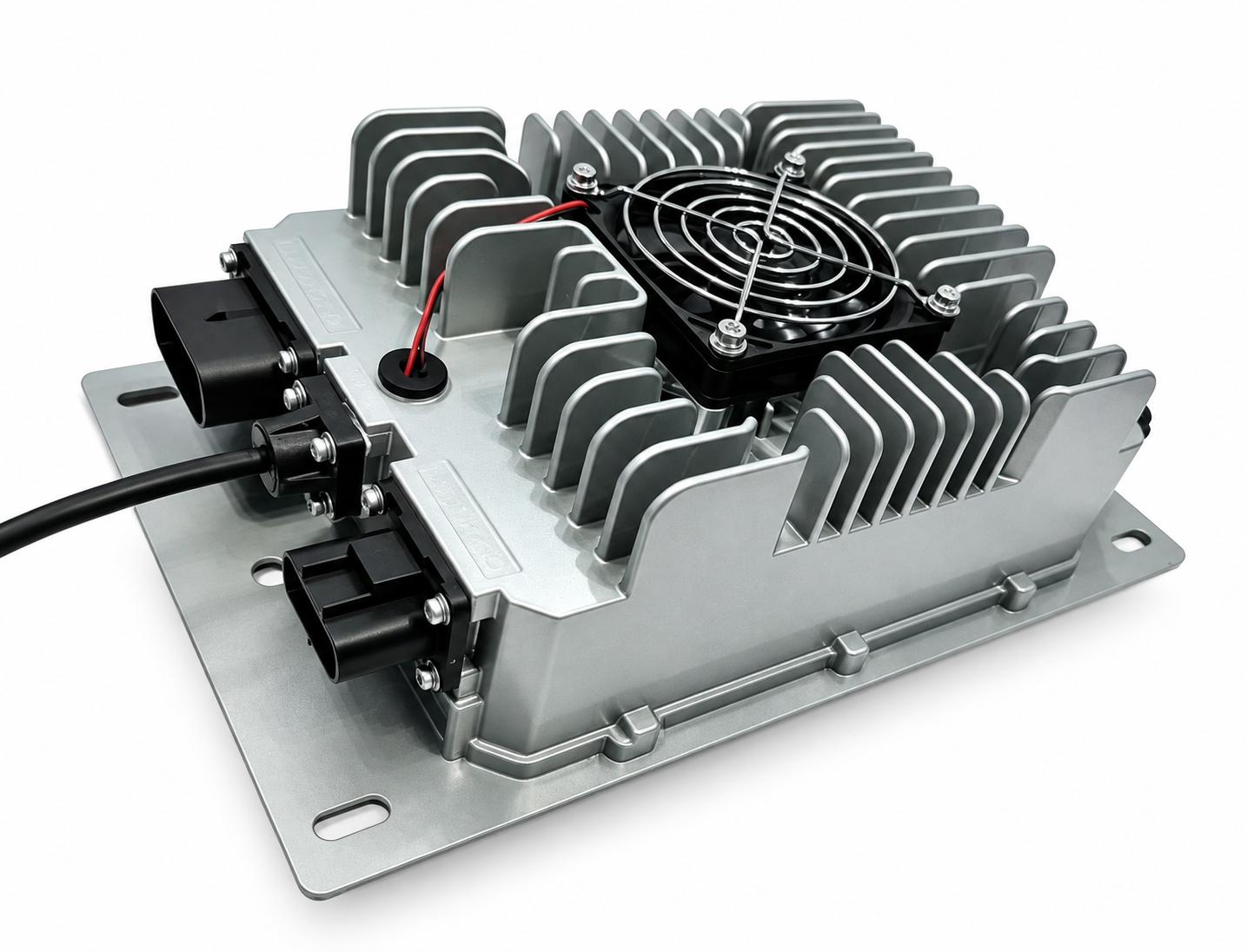
1.5kW OBC 48V + 500W DC-DC 2-in-1 — 1.5kW onboard charger with 500W DC-DC converter in one IP67, air-cooled unit for 48V platforms, with CAN communication and CC/CV charging control.
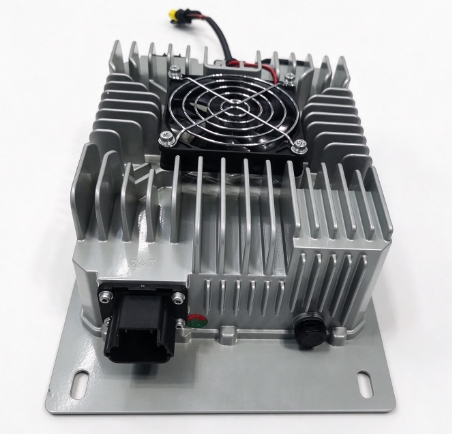
1.5kW OBC 72V + 500W DC-DC 2-in-1 — 1.5kW onboard charger with 500W DC-DC converter in one IP67, air-cooled unit for 72V platforms, with CAN communication and CC/CV charging control.
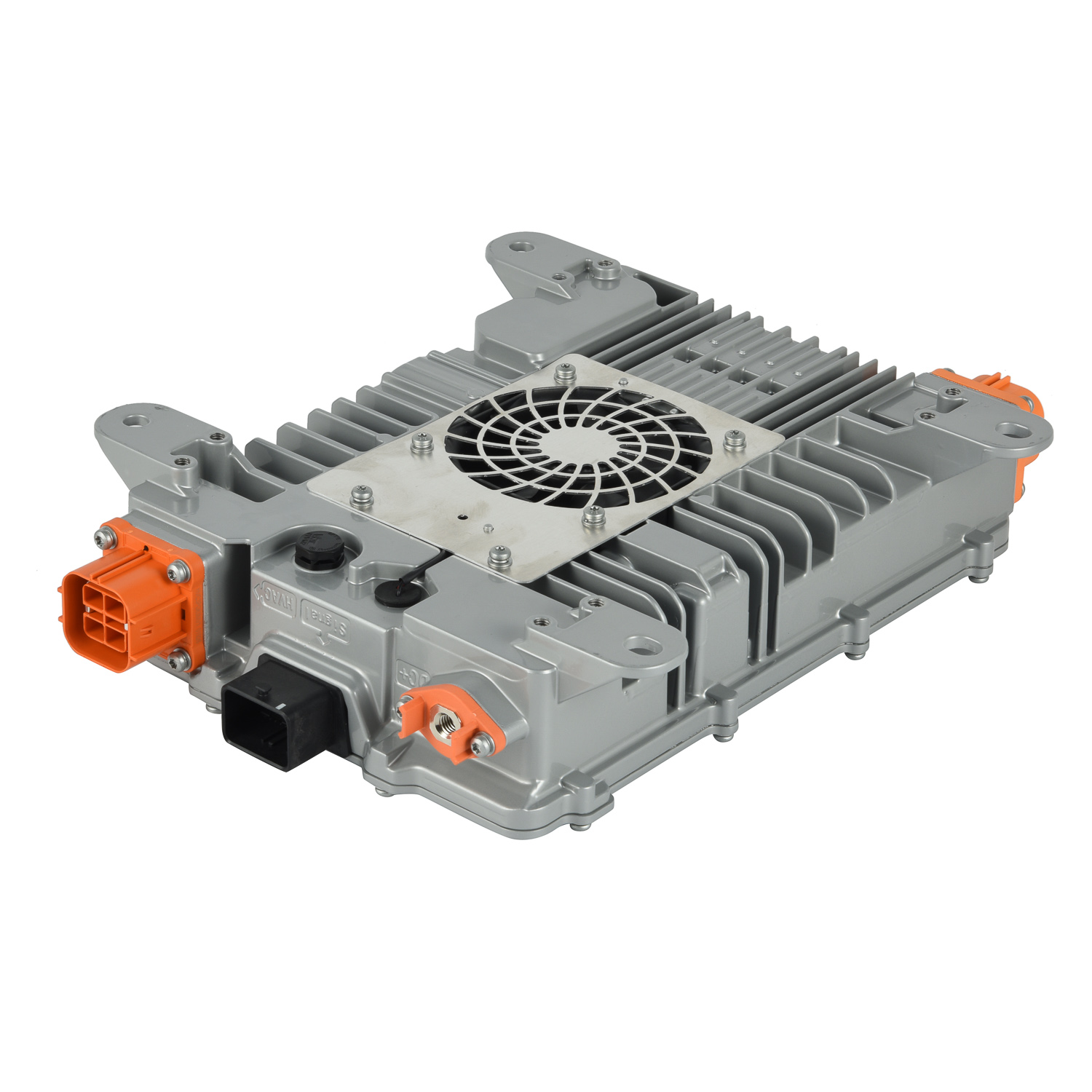
3.3kW OBC + 1kW DC-DC 2-in-1 — Higher-power 2-in-1 option for larger craft or faster charging requirements; verify the product page for platform coverage.
Yes, that is the purpose of the integrated design: the OBC stage charges the traction battery while the DC-DC stage supplies the low-voltage system. Both outputs must be sized for their simultaneous loads.
No. The 48V and 72V versions are separate products, each built for its battery platform. Select the version that matches the boat's full charging voltage range.
IP67 addresses dust ingress and temporary immersion under defined test conditions. Saltwater service also involves corrosion, and the mounting hardware, connectors, and cable entries need their own review. Confirm the full installation with the supplier.
At minimum, provide the battery platform and charging voltage range, the required charging power, the simultaneous 12V load budget, CAN communication requirements, installation space and cooling conditions, and the intended boat application.
Send the Echelon team the boat application, battery platform and charging voltage range, required charging power, simultaneous 12V load budget, and CAN communication requirements, and ask which 2-in-1 configuration fits the boat.
Contact Echelon directly: Email nancy@tici-energy.com · WhatsApp +86 18114665311.
Use the contact form on the contact page to start the discussion, and see how a custom programme is scoped on the OEM/ODM page.


